Umbilical
Hernia

What is an Umbilical Hernia?

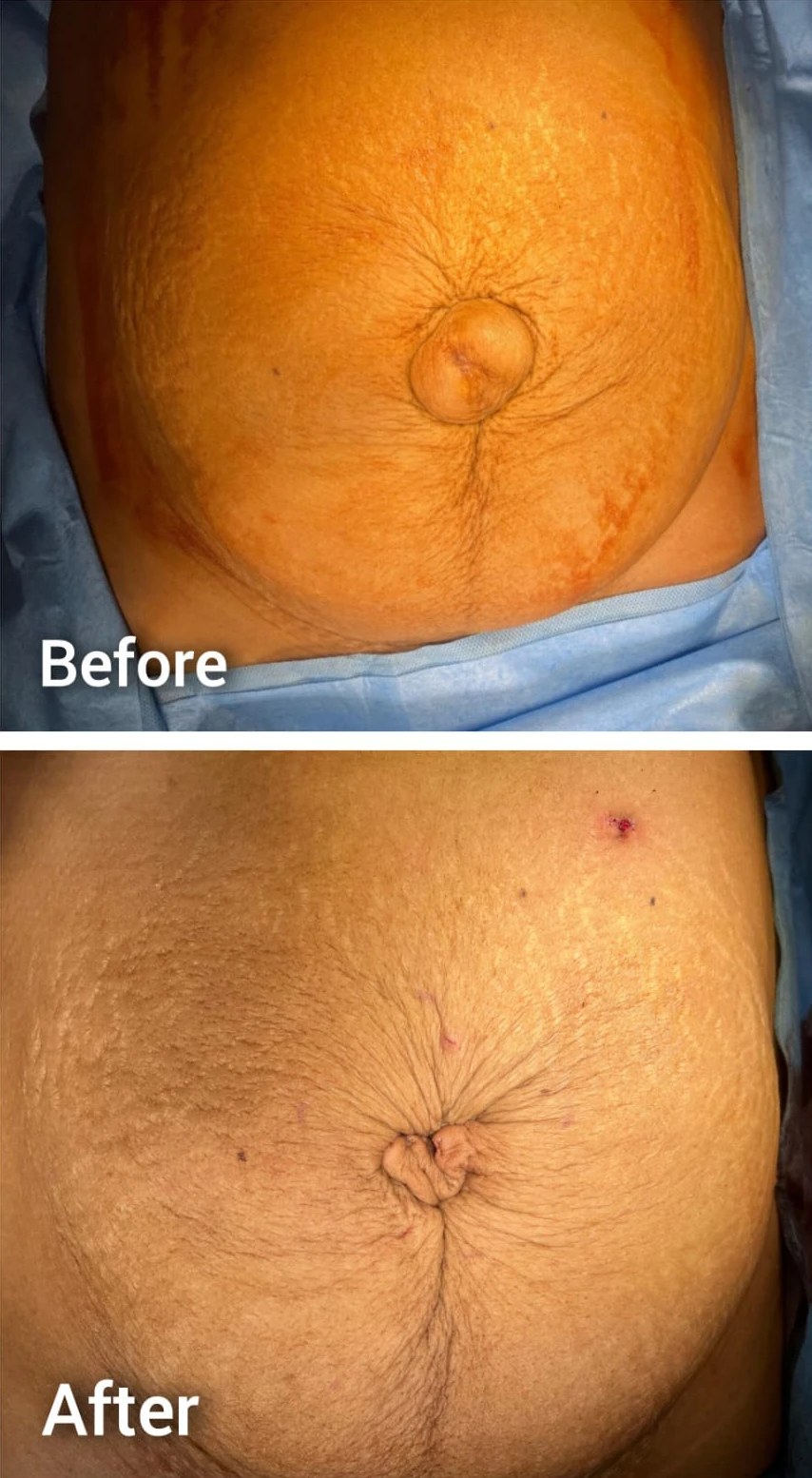
An umbilical hernia is a soft bulge or swelling near the navel (belly button) that becomes more visible when a person stands, coughs, lifts heavy weights, or strains to pass motion.

In advanced cases, the bulge may be seen even while lying down.

It occurs when a portion of the intestine or fatty tissue pushes through a weak spot in the abdominal wall near the umbilicus.

What causes Hernia?

A hernia occurs when an internal part of the body, such as tissue or an organ (like a part of the intestine), pushes through a weakness in the muscle or surrounding tissue wall.

The underlying cause of most hernias is a combination of two main factors:

  • Muscle Weakness or a Defect: A pre-existing weak spot or opening in the muscle or fascia (the strong, fibrous tissue that helps contain organs). This can be:
  • Congenital: Present at birth (e.g., if a natural opening, like where the umbilical cord passes, doesn’t close completely).
  • Acquired: Developing later in life due to aging, injury, or prior surgery (creating an incisional hernia).
  • Excessive Pressure: Any condition or action that significantly increases pressure inside the abdomen can force tissue through a weak spot.

Causes are different in children and adults.

What are the causes of Umbilical Hernia in children?

In babies and young children, umbilical hernias occur when the umbilical ring (the small opening in the abdominal muscles where the umbilical cord passed during pregnancy) does not close completely after birth.

Usually, this opening closes by the age of 4–5 years. Until then, a small hernia may be visible, especially when the child cries or strains.

What causes Umbilical Hernia in adults?

In adults, umbilical hernias happen when increased pressure inside the abdomen pushes through a weakened area of the abdominal wall.

Parts of the intestine or fatty tissue can then bulge out through this weak spot.

What are the risk factors causing Umbilical Hernia ?

Certain factors increase the likelihood of developing an umbilical hernia:

  • Sex: More common in females
  • Obesity: Excess body weight increases abdominal pressure
  • Multiple pregnancies: Repeated stretching weakens abdominal muscles
  • Fluid buildup in the abdomen (ascites): Seen in patients with liver disease (cirrhosis)
  • Previous abdominal surgeries: Weakens the muscle wall
  • Chronic cough or constipation: Repeated straining raises intra-abdominal pressure.

What are the symptoms of Umbilical Hernia?

Umbilical hernia symptoms are similar in both adults and children:

  • Visible bulge: A soft swelling or protrusion near the belly button. It may become more noticeable during coughing, lifting, or straining. In infants, it may be visible when crying.
  • Pain or discomfort:
    • Usually painless in children
    • Adults may experience dull pain, pressure, or heaviness at the site of the hernia

What are the warning symptoms of Umbilical Hernia to visit the doctor immediately?

Seek immediate medical care if you notice:

  • Severe or worsening abdominal pain
  • Bulge that becomes hard, dark, red, or tender
  • Nausea and vomiting
  • Blood in stool
    These symptoms could indicate a strangulated hernia, where blood supply to the trapped intestine is cut off — a medical emergency.
umbilical-hernia

How do we diagnose Umbilical Hernia?

Diagnosis is usually straight forward:

  1. Clinical Examination: Your doctor will assess the size and reducibility of the hernia.
  2. Ultrasound of the Abdomen: Helps measure the hernia defect and detect other abdominal pathologies.
  3. CT Scan (if needed): Used when the hernia is large, multiple previous surgeries exist, or complications are suspected (like obstruction or strangulation).

What are the treatment options available for Umbilical Hernia?

Surgical Treatment

Observation:

Very small hernias without symptoms may not require immediate treatment but should be monitored regularly for changes.

Surgical Treatment:

When should an Umbilical Hernia be operated?

  • Causes discomfort or pain
  • Increases in size
  • Becomes irreducible or complicated

What is the surgery done for an Umbilical Hernia?

The standard procedure is Mesh Repair of Umbilical Hernia – open or laparoscopic (keyhole) methods
This involves:                               

  • Opening the hernia sac
  • Returning the contents to the abdomen
  • Closing the defect
  • Reinforcing the area with a non-absorbable mesh to prevent recurrence

Who can undergo laparoscopic mesh repair?

Surgically fit patients who can withstand general anaesthesia can undergo laparoscopic mesh repair.

What is laparoscopic Mesh Repair?

Laparoscopic mesh repair is a minimally invasive keyhole surgery performed under general anesthesia using three small incisions.

The hernia is repaired from inside, and the mesh is placed within the abdominal cavity (intraperitoneally).

Advantages include:
✅ Minimal pain
✅ Short hospital stay (1–2 days)
✅ Early return to normal activities
✅ Tiny scars (almost invisible)
✅ Very low recurrence rates

What are the advantages of laparoscopic mesh repair?

Very less hospitalisation time(1-2 days), no pain, so early return to work, very small scars (practically invisible), excellent results (no recurrence)
Who can undergo open surgery?

  • In case of medically unfit patient with respiratory (lung problem), cardiac (heart) problem, cirrhotics (liver problem) etc.,
  • Complicated umbilical hernias like strangulated, gangrenous bowel, multiple repairs done earlier

What is the post-operative care after Umbilical Hernia Surgery?

Immediately after surgery:

  • Avoid excessive coughing or constipation
  • Avoid lifting heavy weights
  • Watch for any signs of wound infection (redness, swelling, discharge) and report immediately

Long-term care:

  • The mesh fully integrates with the body over 6–8 months
  • During this period, avoid heavy lifting or straining
  • Manage cough and constipation promptly
  • Maintain a healthy weight
  • Light exercises like walking are encouraged to prevent recurrence

Frequently Asked Questions (FAQs)

What happens if an umbilical hernia is left untreated?

Untreated hernias may become irreducible, and the trapped intestine may lose its blood supply, leading to gangrene, sepsis, and life-threatening complications.

Is it a major surgery?

No. Umbilical hernia repair is a simple and safe surgical procedure performed routinely with excellent outcomes.

How many days of rest are needed after surgery?

After laparoscopic repair, patients are usually discharged the next day.

  • Normal activities like walking, climbing stairs, and eating can resume the next day.
  • Desk job: Return to work in 3 days
  • Manual labor: Avoid heavy lifting for 6–8 weeks
Can we treat umbilical hernia with medicines?

No. Since it is a mechanical defect, medicines cannot close the defect.

At The Best Gastro Care Center

Your Health, Our Priority

Our expert team provides world-class treatment for gastrointestinal diseases using advanced techniques and compassionate care.

📞 Book your appointment today to consult our specialist gastro for timely diagnosis and treatment.